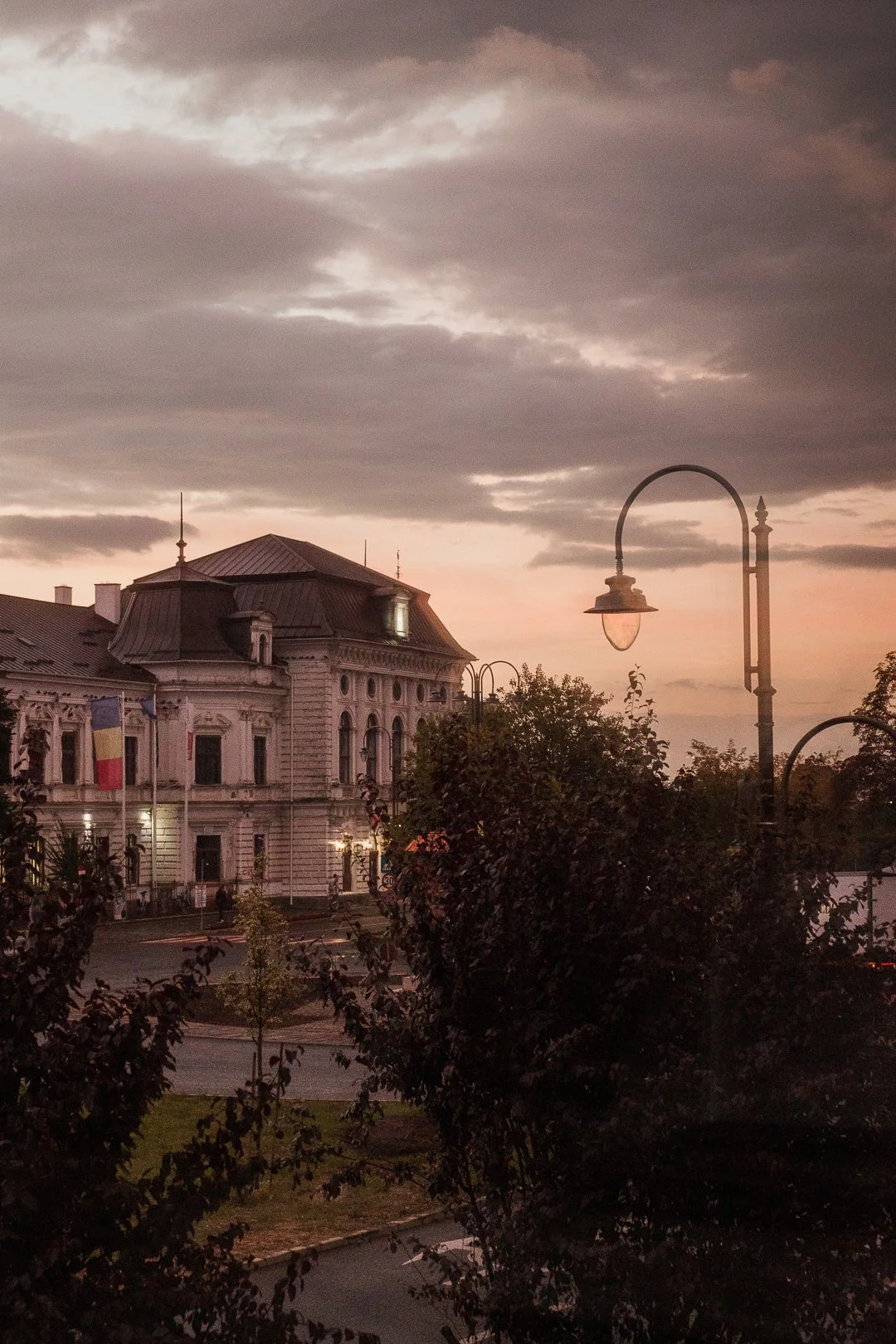
I awoke in darkness. This hour ahead of my home time zone would take some getting used to. But I had no complaints, as today I had a plan and the sky was filling with pink over the centre of Turda. I breathed deeply with the contentedness of someone in charge of her own schedule, and got ready for the day.
My plan was to get to the Turda Salt Mine at 9:00 am when it opened, go down and explore a bit with my camera, then drive to Viscri with a stop in Sighisoara to stretch my legs. A friend of mine from FSY messaged me, saying she was just finishing up her studies in Cluj. She gave me a few sightseeing and driving tips, which I appreciated.
I checked out by putting my keys back in the lockbox by my door, considered stopping at an ATM, but then chose to go directly to the mine, which was about 10 minutes from my accommodation. I knew I wanted the old entrance, which I did find after a bit of negotiating with Google Maps. Honestly, the way it sometimes leads me makes me wonder.
Once parked in one of the last spots in the parking lot, I stepped out and swung my camera bag onto my shoulders. When planning this trip, I’d second guessed whether I wanted to go into the mine. Was it worth my time, seeing as I was actually on a work trip collecting images of creation? My concern was that the mine would be too modern to fit. But, I wanted to see the patterns of salt in the stone.
And my youngest loves rocks and wants to become a geologist when she’s grown, so ultimately I decided to just stop by and see. As soon as I entered and located the help desk, I saw a graphic of a camera with a line through it. Asking the attendant, she said no professional photography was allowed. Only mobile phone cameras. Well, I was carrying over 9kg of camera gear on my back and that meant I’d be carrying it through the whole tour.
I turned myself around to the other side of the entrance, the gift shop, and bought my girl a small salt lamp that changes colours. Then I continued on my journey to Sighisoara, and ultimately, to Viscri or Bunesti, where my night’s accommodation was waiting.
Somehow, I’d had it in my mind’s eye that I’d be traveling through evergreen forests, but the land around me was filled with rolling agricultural hills punctuated by villages and topped by rust coloured deciduous trees. Farm stands lined the roads, with beautifully plaited garlics, peppers, and other vegetables hanging like colourful neckties swaying in the breeze.
I would have taken home several in a heartbeat if I’d thought I could get them through in my suitcase.
The Puma I was driving and I also made room at times for horse drawn wagons on the road. In the fields that lined the roads, I could see shepherds tending their flocks. This was no highway between Cluj and Sighisoara. It was, at best, a long river of road connecting small villages and bits of history.
At one roundabout, as fate would have it, Google Maps chose me a way that did lead out of the line of the slow going villages. In fact, the further I went, the sparser it became until the road turned to dirt. I paused briefly, checked the map, trusted that it was a legitimate route, and headed forward into the dust with my little white car.
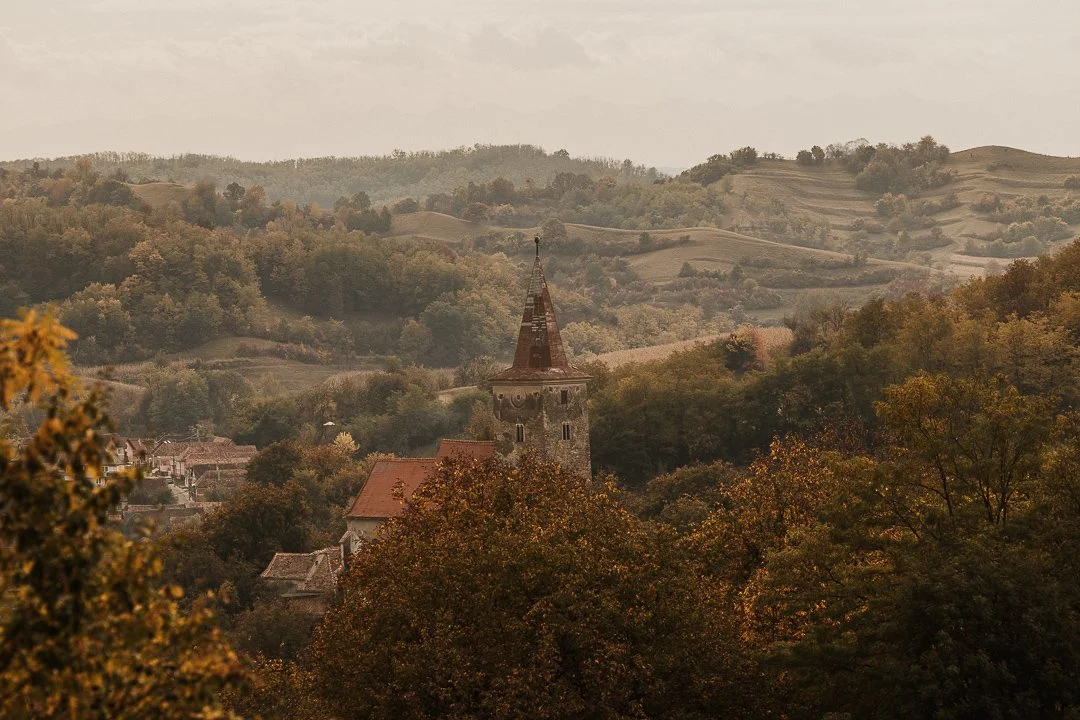
I’d taken the wrong turn in Tarnaveni, so instead of taking the 14A down, I took the 142A. This unexpected detour led me into a gold-hued tree line where leaves rained down on my car at every hairpin turn I made. It was breathtaking, and I was certain I would continue without problem once I descended from the heights.
This involved driving through a hillside village with views over a church in a valley. I stopped for a moment by a hillside graveyard, breathed, and looked over the view.
Once I had my bearings again, I continued my descent into Sighisoara.
Having lived in Europe for years, I knew the easiest way to explore a city was to navigate to a car park and just pay for parking. With that smugly in mind, I drove on. The map said it would take an hour’s time, but the map also forgot to include the turns in the road, slow drivers, cyclists, or more. But, eventually, I entered Sighisoara. The streets constricted in size, as if that was possible, but I confidently continued.
Once I’d reached the car park, I realised that this was a very popular car park. It was triangular in shape, with both the outside perimeter and the inner lined with autos. In fact, as I carefully pulled forward, I realised even the through street was full with parked cars. Unless I backed out the length of the car park, I was going nowhere. So, carefully and with a keen eye on my rear view camera, I backed up. Then I drove up a side street until I found a place I could pull over.
Breathing deeply, I calmed myself and ate some of my road snacks. If I have one huge fault as a traveller, it’s forgetting to eat. After years of gastroparesis, I just do not get hunger signals; especially when I’m focused. Or stressed.
I did not dare park long, though, as I did not want a ticket. So, I set the navigation to another car park nearby, and wound my way around the outer streets at the base of the citadel. Finally, I found it. The parking. It was perfect, and close to the old citadel. I got out of my car to pay, but none of the parking meters accepted card payments. I then scanned the QR code on signs for an app to pay electronically, but I was blocked from downloading those apps as my phone was from a different geographical area.
I’d seen no ATM in the airport, and hadn’t stopped in Turda, and now I had no cash to pay. And I was getting tired.
So, I set a destination to an ATM on my way to my accommodation. I could just as easily visit Sighisoara on the way back up to the airport, anyway. Back in charge of my time, and tired, I drove on southward.
Viscri and Sighisoara are only about 35-45 minutes apart. The ATM I’d targeted was in between. As I approached its location, I was dismayed to see the center of the village was torn out for road construction. There would be no ATM access on the way to Viscri, and there was no ATM in Viscri itself.
This is solvable, I thought to myself, as I continued on my way. Shortly thereafter, I reached the village of Bunesti. My accommodation itself said it was in Viscri, but the address pin landed in Bunesti on the main highway. I turned off on the one road of the village that wasn’t highway, consulted maps, puzzled, drove in circles in that tiny village, and even pulled up and waited at a gate along the highway trying to reach my host to find her address.
It was at this point I realised she spoke only Romanian.
I heard her tell me not Bunesti, but Viscri. Those few weeks of DuoLingo Romanian really came in clutch! So I told her I’d continue to Viscri, and I’d find her house. I was pretty sure I’d insulted her by insinuating her house was in Bunesti and not Viscri, too.
This was a fine arrival.
I was relieved, though, that the road into Viscri was fully paved. Once there, I began again to make my circles and backtracks carefully as I searched for her house number. You’d think for villages with one main street it would not be so hard for me to find my way. And I often pride myself on my way finding abilities! But they were of little use where I knew neither topography nor much of the language.
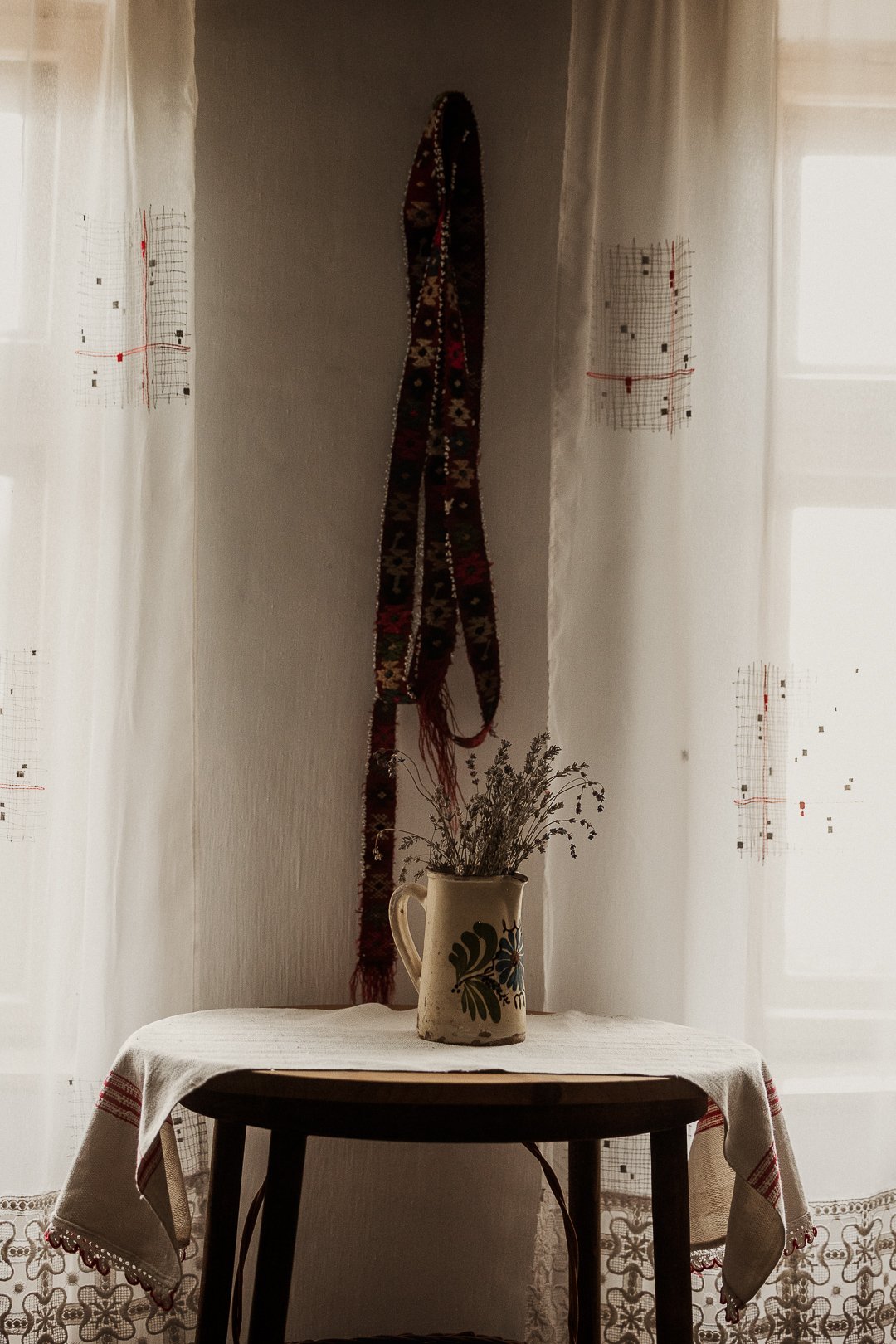
Finally, turning off the cobbled streets onto a dirt road, I found it. A beautiful old farm house with gated courtyard, red roses, and a kitten.
My host, Raluca, met me at the gate and told me I could pull into her front drive behind some fencing. I got out, relieved, exhausted, and slightly bewildered.
I’d arrived!
Raluca, standing with a fedora like hat on her head and the look of someone who had many more things to be doing, gave me two skeleton keys, for the gate and my room, and led me to my upstairs accommodation. There, a fire was already crackling in the wood burning stove. Raluca said she would tend to my fire if that was alright with me, and I nodded my agreement.
Then she left the room, and I was left to myself. First, naturally, the toilet. I was surprised to see a hand written sign in English that read ‘do not flush the paper, put in waste bin,’ taped to the toilet basin. Okay, I thought to myself, this is what we do here.
Feeling refreshed and itching to get out, I hoisted my camera backpack on and set out the door, not quite figuring out how to use the skeleton keys that sat safely in my trouser pocket. Since I had the most expensive equipment with me, I figured I’d just go and see.
So I walked, starting from my accommodation, up the hill to church.
Viscri is home to one of seven UNESCO World Heritage fortified churches, built by the Saxons to withstand attacks from the Ottomans and Tatars. A fortified church is a dual purpose building. It serves both as religious centre and military structure. There are more than 150 fortified churches still standing in Transylvania.
That was not why I came to Viscri, though, if I was honest. It was a bonus to explore within a well preserved Saxon village. I’d picked Viscri because here I could find the atmosphere I wanted within driving distance of Brasov, where I’d promised to attend church.
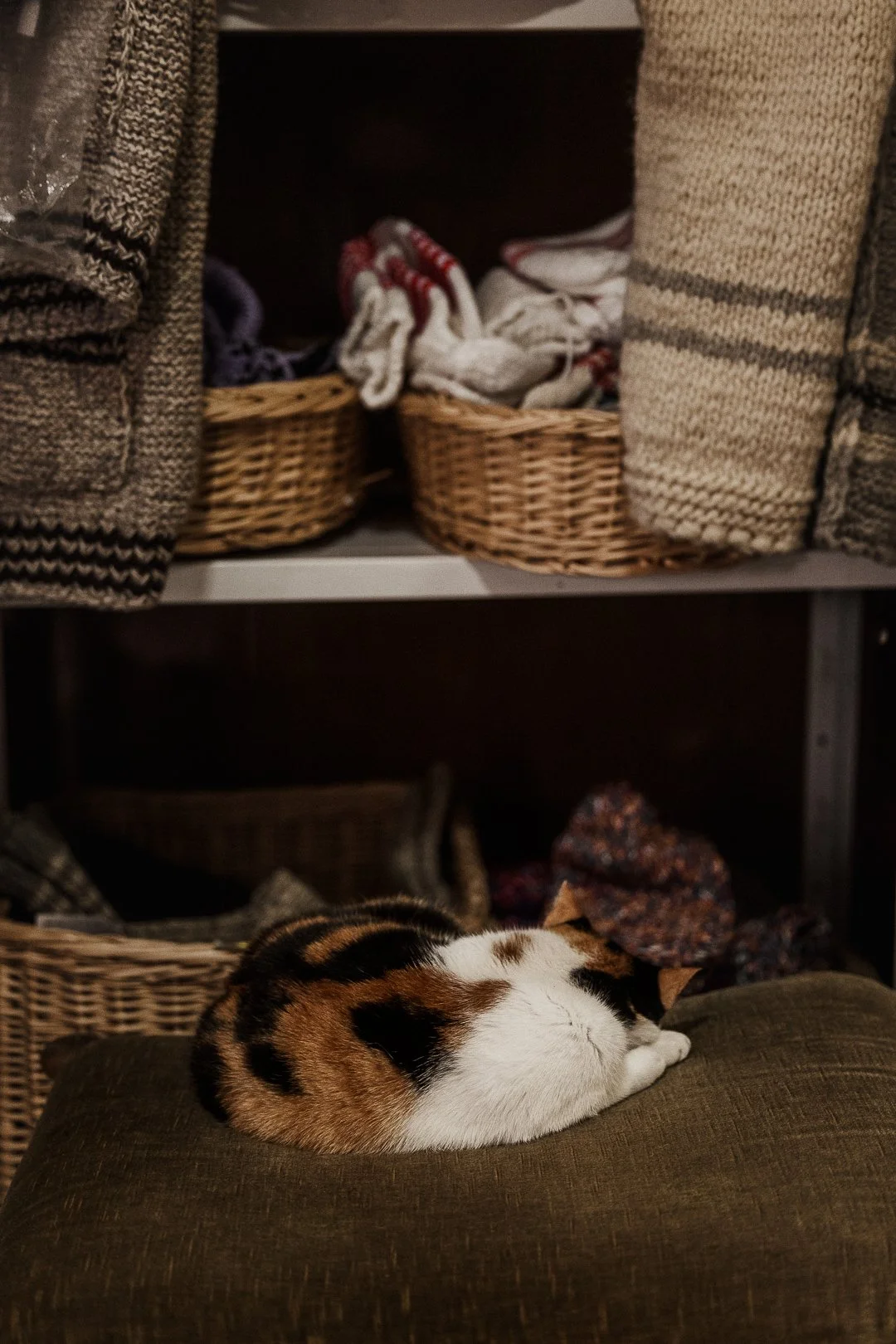
Of course, some of this was churning in the back of my mind as I hiked up the dusty dirt road of Viscri. First, I stopped at a small shop selling woollen goods, drinks, and ice cream. These would be the best souvenirs to take home to family, I determined. I photographed the cat sleeping next to the shopkeeper who was knitting, and promised I’d return later.
Then, I continued with eyes open. Chickens, dogs, cats, and the occasional horse wandered freely in the streets. It was clear whoever coined the phrase ‘quiet village life’ had never truly lived in a village. Children rode on bikes and scooters, or played games of hide and seek in the streets. Grandmothers sat on benches to watch the tourists and gossip. It was an incredibly interconnected feeling, life in the village of Viscri.
I shifted the pack on my shoulders and adjusted the camera strap around my neck. Here, as in Albania, I was determined to capture the elements and to leave the people largely alone. They did not ask to become some kind of tableau on a site that they had no knowledge of. I was here for the dust, the mist, and the grit of what made Viscri without stealing faces.
I turned at the gate to the fortified church and entered, following an even more steeply rising uphill path. There, I was met by a friendly dog. I entered the building where they were selling tickets, and found out the church and tower were undergoing extensive renovation, and as such, were not open to be visited. But the rest of the structure within the walls was open at a discounted rate.
I bought my ticket (thankfully they had a card reader), and then entered the walls. Only I was immediately met with a sign that said no professional photography. So, I returned to the ticket office and asked for clarification. They said that they’d had so many photographers and influencers coming and posing in great big dresses and taking up so much room, they’d had to put the limitation in place. I explained I was much more of a travel photographer and just photographing to tell about my experience there. That wasn’t a problem.
With that clarified, I entered once again and began looking in all of the nooks and corners of the walled church. Here, a potted geranium brightened a window. There, old wood hewn benches lined the inner wall. I stood in the open doorway of the old church and peered inside there, too. The smell of old plaster reminded me of our own Dutch monument home we’d lived in for six years.
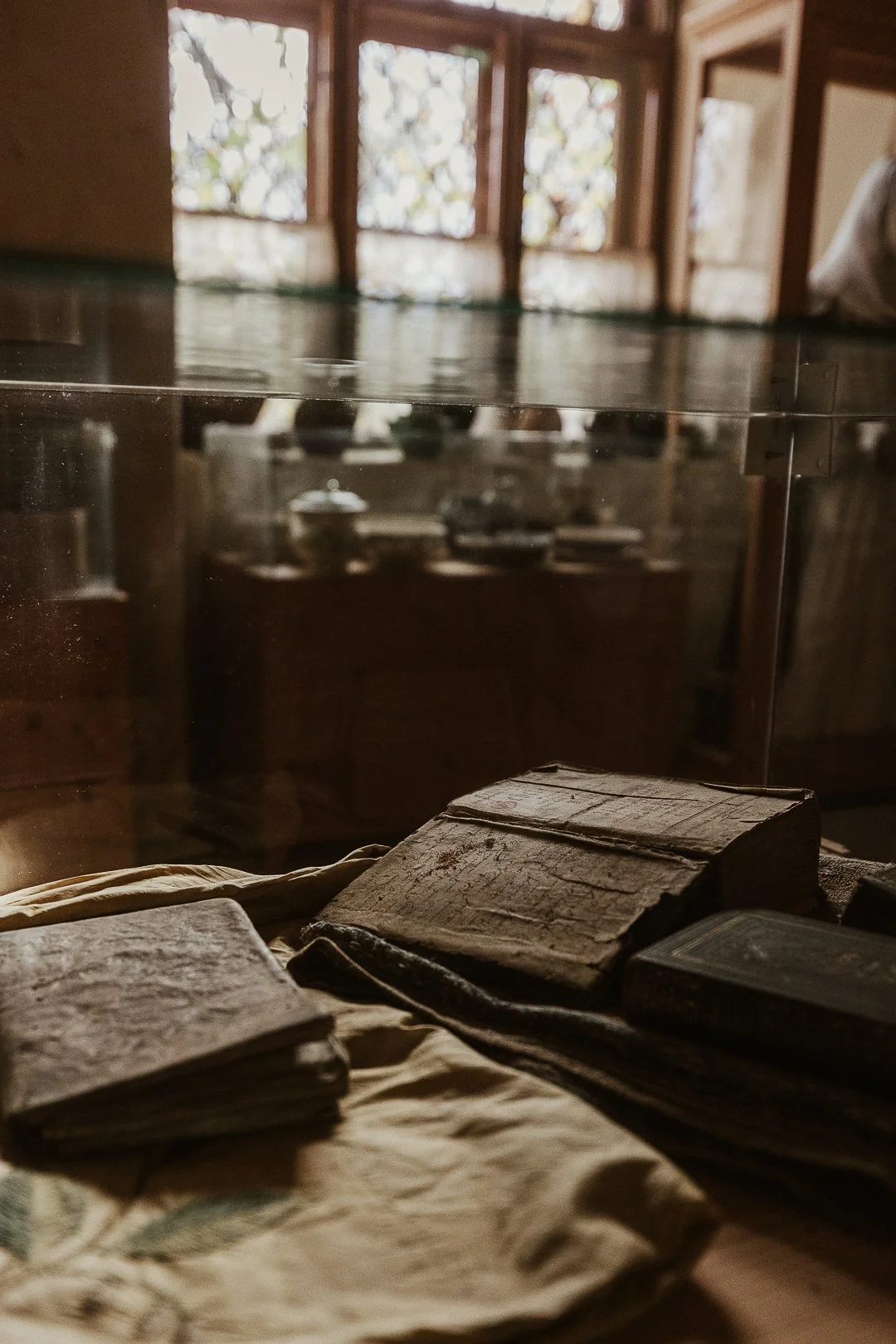
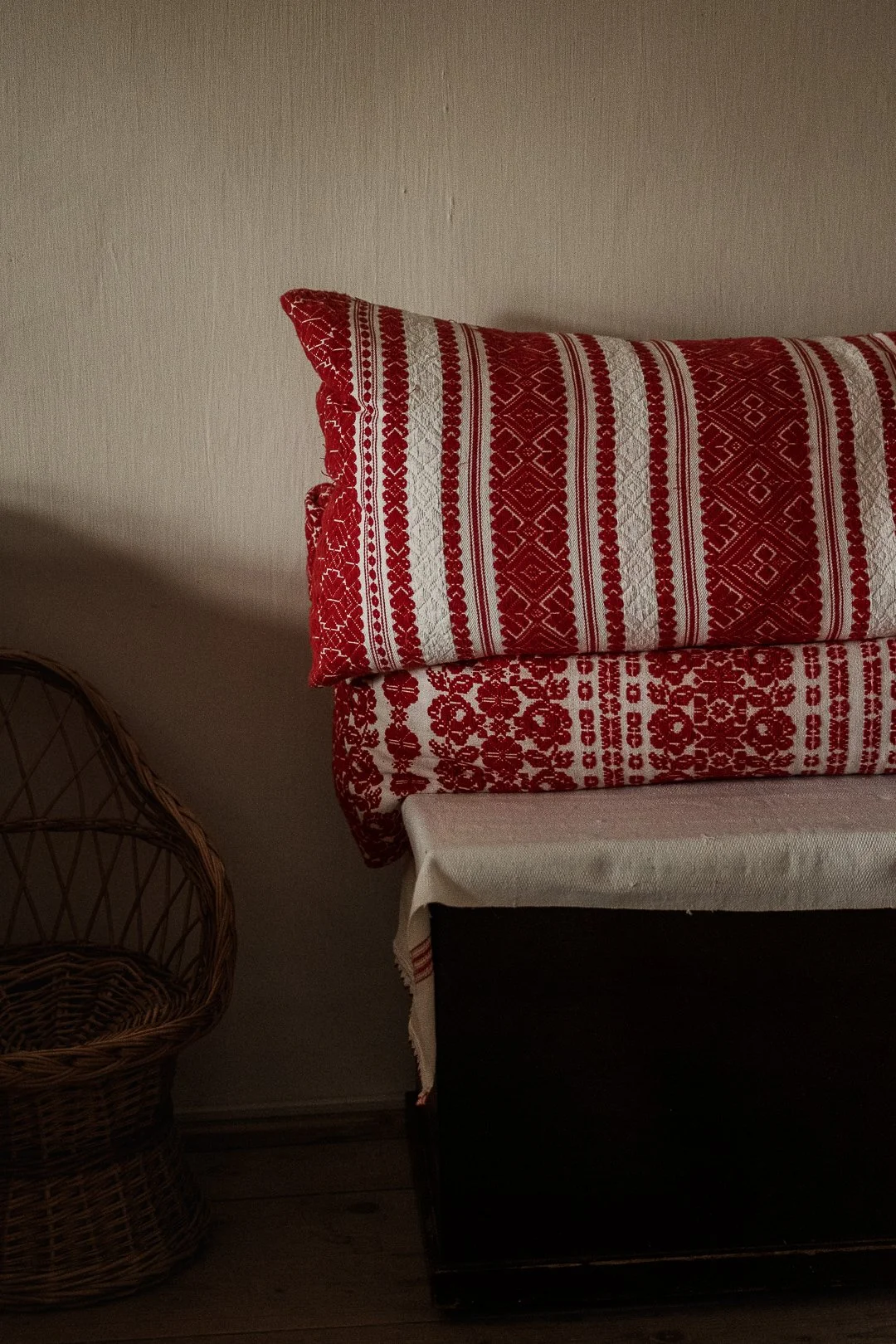
Then, I searched the buildings top to bottom, finding displays about how life was organised in the Saxon villages, and the weaving and needlework this region was known for.
I was particularly fascinated by a sign teaching about Reconciliation Day. Having just travelled to Albania last month and seen the Lock In Tower in Theth, I’ve had reconciliation on the mind. Drawn from Michael Wagner’s memoir Schicksale und Erinnerungen (Fates and Memories), the display described how every year on the Tuesday before Ash Wednesday, the village men in Viscri held Reconciliation Day. At noon they entered, in order of age, the room where the two neighbourhood fathers waited, and made peace with one another. Then the year’s accounts were read aloud, including fines for anyone who had missed communal work or a burial. Fines were paid and recorded, next year’s work was discussed, and the accounts were passed to every neighbour to check. Finally, the two youngest men signed the record, and the day was done.
I couldn’t help realising we had so much to learn, from both countries I’d just visited.
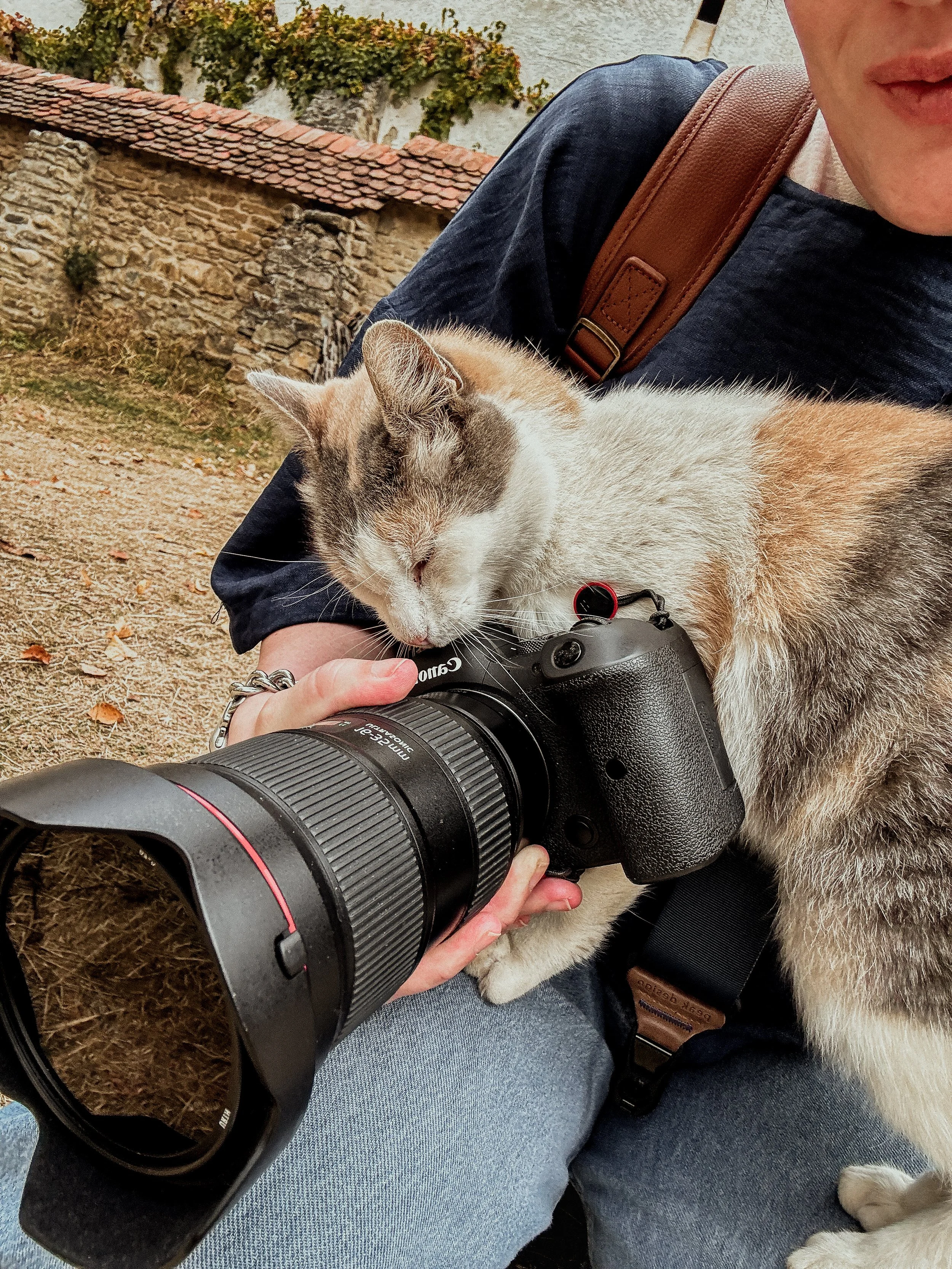
The late afternoon sun shone golden in the windows of the room, and I knew closing time was approaching. So, I went out to the front of the fortified church for a few more photos of the structure and to make sure I did not miss the photo display in the side room. Once out, I met a friendly cat. I crouched to pet her, and she climbed into my lap, studying the camera I had in hand. Then, without missing a beat or doubting my goodwill, she climbed onto my backpack for a ride, much to the amusement of myself and other visitors.
This simple moment helped wash some of that travel dust of a long day from my soul. I headed slowly back to my guest house, taking a slightly different route. I arrived to find a small boy helping Raluca furiously scrub the stone tiles in the garden courtyard. I asked Raluca if I still could order dinner for the night. Using our hands to tell the time, she told me dinner would be ready at 8pm, and she showed me a small dining room just off the courtyard where she said she would serve me meals. No worries, I thought, as I was tired and wanted to just unwind a bit in my room and rest. I still was not sure Raluca liked me, I mused.
I sat down on the carpeted wood floor by my bed by the fire, organising my suitcase and going through the day’s photos. Doubt started to creep in. What was I doing here anyway? Was it even a good idea? Just as fatigue and doubt began to settle, I heard the sound of lowing. Springing from my cross-legged position on the floor, I rushed to the windows of the bedroom. There, out on the dust of the street, the cows were coming home.
They made their way down all sides of the street, some stopping occasionally to catch another mouthful of grass on their way to their beds for the night. I stood transfixed with delight, and pulled out my phone to make a video. This I sent immediately to my husband, who’d grown up on a farm in the States. Maybe this place would not hold the same majestic delight of Albania, but I knew it would likely heal something in my husband if he were to get to stay in Viscri.
The light faded quickly after the cows, but the sounds of families and gatherings continued into the dark. Just after 8, I made my way downstairs to the courtyard dining room. Here, too, a fire was stoked and burning in a wood burning stove. Raluca was so good at that, I noticed. When we’d previously had fireplaces in homes, it took me a lot of kindling and several matches to get something resembling a fire going. Here, Raluca’s hands just knew fire.
But Raluca was not in the room. I was alone. There, a wooden carved table decked with bright white table cloth, was a flat bowl with a meatball soup standing waiting for me. So, too, were a mug and tea pot. I realised I needed to communicate my religious dietary needs to my host. As I sat down alone in that room with the white table cloth and the black sky outside, hearing the sheep and the pigs in the farmyard just beyond the courtyard all safely gathered in, I felt alone.
And though I did not particularly like the silence, I understood that this stillness was good for me. Married at 18, and raising children for the last two decades, I hadn’t had true stillness perhaps ever. And, looking at the whiteness of the cloth carefully embroidered and spread before me, it felt sacramental. I sat, breaking bread and dipping it in the soup, pondering on how a lifetime of sacraments meant I could feel when something was nearing that meal of devotion.
I’d finished the soup and was heading back to my room when Raluca reappeared, with the second course.
Naturally, this is when I started to get worried.
My stomach, after years of gastroparesis, struggles with a full plate. And yet here, I was getting more than one course with no insight into what I would be eating or how many courses would come.
I thought ‘stiff upper lip, girl,’ and dove in to do my best. The second serving was a bit of fried chicken and creamed spinach. I knew I could eat the chicken and I made it part way through the spinach. It had all the warmth and goodness of true comfort food, but my stomach started to send SOS signals that it was nearing over capacity.
I took this moment to use Google Translate to explain to Raluca that, because of my faith, I drink neither alcohol nor coffee. I asked for water and she brought me a bottle of carbonated water. I really hoped that the translation feature was communicating what I needed it to, since sometimes they can really be messed up.
I also communicated that on Sunday, I would not need breakfast nor dinner because I would be travelling to go to church in Brasov. This piqued her interest. She asked if I was a believer. I said yes, and I showed her my website. I told her I am a photographer and I travel to photograph images about the seven days of creation.
Her eyes lit up. She hurried from the room, and came back with dessert crepes.
The third course. I ate them, and knew I’d reached critical levels of fullness.
Raluca came with me back to my room to stoke the fire for the night. Once I entered the hall leading up to my room, I carefully removed my shoes. I finally understood. I’d seen enough of how the cows and animals treated the streets I’d been walking on to know that outside shoes were not for in my room. Then she and I went up to the rooms.
She spoke into her phone and it translated into “I have read the Bible often and it is a comfort to me.” Suddenly, across the language, distance, and cultural barriers, we were just two women with the same faith. Suddenly, travelling to Viscri did not feel like such a mistake.
Raluca showed me how to lock my room from inside by sliding the antique bolt to the side, then we said good night to each other in Romanian, with her helping me with my pronunciation. I’d watched her quietly in our interactions all day, and seen how hard working she was. When she was loading wood into the stove, I saw that her hands were hard from the work.
Me? I couldn’t work a skeleton key.
As I settled into my bed by the fire for the night, I snuggled in so comfortably with the warmth, a sweet wood burning smell, and an ember glow enfolding the room. In the corner behind the wood burner, I noticed a tool I’d seen labelled up at the fortified church earlier that afternoon.
A distaff leaned against the wall.
Know before you go
Romania is an hour ahead of the Netherlands (and most of Western Europe). Factor it into pickup and check-in times.
If you are visiting the interior of Romania, find an ATM and take cash.
When an ATM or card machine offers to charge you in euros, decline and choose lei. It saves you money.
Revolut is also usually a reliable way to make card transactions in the local currency. I only use it for travel and only top up the card when I’m travelling.
I was unable to download any parking apps to pay for parking, so carry the local currency.
A lot of the public toilets require a small payment to use, around 2 lei, so keep some change on hand.
Many toilets cannot handle flushed toilet paper, so put your used toilet paper in the waste bin provided by the toilet.
Download Romanian on Google Translate before you go so that you can communicate with people who don’t speak your language.
Have WhatsApp and mobile data ready. Many hosts communicate that way. EU numbers roam free in Romania; non-EU visitors may want an eSIM.
Not all information listed on Booking.com is accurate. Always try to double check your accommodation and read other reviews.
Always carry a credit card in the driver’s name to avoid any possible complications when you pick up your car.
When you pick up your rental, film a slow walk around the car, including existing dents and scratches, before you drive off.
Give yourself extra drive time to get to destinations as the road conditions may not be reflected on Google Maps.
Shops listed online may have closed or moved, so be ready to wander.
Speed limits are generally 50 km/h in towns, 90 km/h on smaller roads and 130 km/h on motorways, but local drivers often go faster and will tailgate or overtake. Drive at a pace you’re comfortable with and let them pass when it’s safe.
Watch for slow traffic. Horse carts, livestock and tractors are common on village roads, especially around Viscri.
The Details
Turda Accommodation: Belle View Apart Hotel, nr.9A, Piața 1 Decembrie 1918, 401130 Turda, Romania
Viscri Accommodation: Facilitati cazare Raluca, 335W+9X Viscri, Romania
Cluj Accommodation: Cashmere Apartment, Strada Traian Vuia 194 37, 400394 Cluj-Napoca, Romania
My Church: Biserica lui Isus Hristos a Sfinților din Zilele din Urmă, Str. Artur Leiter 2, 500446 Brașov, Romania
Viscri Fortified Church: Evanghelic C.A. Fortified Church Viscri, Bisericii Nr. 47 Com. Bunești, 507039 Viscri, Romania
Viscri store with handknit goods: Magazin mixt si Produse naturale lucrate manual, 333R+PW Viscri, Romania
Viscri “Holy Trinity” Orthodox Church: Biserica "Sfânta Treime" și "Sf. Cuv. Mc. Efrem cel Nou”, Str Principala nr 112, 507039 Viscri, Romania
Car Rental: Budget, Cluj „Avram Iancu” International Airport, Strada Traian Vuia, incinta, 400397 Cluj-Napoca, Romania
Fortress: Rupea Citadel, Strada Cetății, 505500 Rupea, Romania
ATM: BCR, Str. Republicii 107, 505500 Rupea, Romania
Groceries: Penny, Str. Republicii 266, 505500 Rupea, Romania
Parking: Parcare Autoturisme si Autocare, 6QCR+R2 Sighișoara, Romania
Antiques: Antique & vintage, Strada Zidul Cetăţii 11, 545400 Sighișoara, Romania
The Sound
I meant to start a fresh playlist for this trip, but the old one wouldn’t let me go. So Albania’s soundtrack travelled on to Romania, and grew along the way. Everything from track 90 onward belongs to this chapter.